Rabu, 15 Juni 2011

Top Ten Places to Eat


Bozeman offers a variety of cafes and restaurants scattered throughout town that are bound to delight any appetite. Although difficult to pick just ten local favorites, this list adheres to establishments that offer unparalleled atmosphere and food, all the while showcasing the character of Bozeman. See for yourself what the hype is all about.
The Nova Café

Located in the heart of bustling downtown, the Nova maintains its’ local favoritism as the best breakfast in town. What makes this place so special is that the food is fresh, healthy, and delicious and is brought to our tables by supporting the farmers and producers in our community. Pair the mouthwatering huckleberry cream cheese stuffed french toast with a cup of their ‘black bear’ jasmine and vanilla tea.
Open daily from 7 a.m. until 2 p.m.
A meal here will run you from $8-$12.
Contact Nova at 406-587-3973!.
The Cat-Eye Café

For a cheerful, tasty, yet unusual breakfast experience, try the cat-eye. As the name suggests, the décor, menu, and even the staff are all adorned in cat-like paraphernalia. Try the fishbowl, a mixture of salmon, cream cheese, spinach, and tomatoes. One fun little perk is that wearing cat-eye glasses throughout your meal is good for 50 cents off your ticket! Oh yah, expect your server to be a little catty, all in good fun of course.
Open for breakfast Monday – Friday from 7 a.m. until 2:30 p.m. and on weekends from 7 a.m. until 2 p.m.
Breakfasts here are hefty and average around $8.
Contact the Cat-Eye at 406-587-8844.
The Garage

A no-nonsense, get down to business, and dig in kind of place. In the heart of downtown, the expansive patio overlooks all of the main street commotion. The menu is printed on an array of makeshift license plates, offering a good variety and heaping portions of pasta’s, burgers, and salads. Try the ’57 chevy’ burger on ciabatta bread!
Open 7 days a week from 11 a.m. until 9 p.m.
Main courses average around $10.
Contact the Garage at 406-585-8558.
Montana Ale Works

Originally an old railroad warehouse, Ale Works has transformed itself into a hands down local favorite hangout. The beauty of this restaurant is that it has a very ‘at home’ appeal to it, welcoming families of all ages, cowboys, college students, or visitors just passing through. Overflowing with friendly staff and good music, the menu items are some of the tastiest and most reasonable in town. Along with a full bar, Ale Works features the largest selection of Montana microbrews in town, showcasing beers from all over the state. The spinach-artichoke dip paired with a pint of the snake river brew is a winner.
The restaurant is open 7 days a week from 4 p.m. until 10 p.m., with the bar staying open until 11 a.m. On Fridays and Saturdays, the restaurant stays open until 11 p.m., with the bar open until 12 a.m.
Reasonably priced, expect to pay around $12-$15 for a main course.
Contact Ale Works at 406-587-7700.
Daves Sushi

For the tastiest, most creative, and fattest sushi rolls in town, head to Dave’s. This quaint little spot has serious character, with personality ridden staff members and a vast menu of delicious raw aquatic vertebrae. Enjoy the sweet sunshine outside on the patio during summer or warm up inside with a bit of warmed sake or hot tea on the chillier days. A little insider tip? Ask about the Gobbler roll, it is not on the menu but remains a fat and delicious local favorite.
Open Monday – Thursday from 11 a.m. until 9:30 p.m. and Fridays – Saturdays from 11 a.m. until 10 p.m., closed on Sundays.
Expect to shell out around $8-$12 for a specialty roll.
Contact Daves Sushi at 406-556-1351.
Café Zydeco

I really can’t say enough good things about this place. Café Zydeco is the place to go when you are craving thick, spicy, flavorful, and melt in your mouth Cajun food. This modest restaurant is small and off the beaten path but packs a serious punch when it comes to cuisine. The chicken and spicy sausage gumbo will leave you speechless, not to mention the mind numbing effects of the Creole chicken philly.
Open M-W from 11 until 3, Th-F from 11 until 8, Saturdays from 9-4, and Sundays from 9-3.
Menu items average around $8.
Contact Café Zydeco at 406-994-0188.
Over the Tapas

One of the finest places Bozeman has to offer for that intimate date setting you may be looking for. Tapas boasts a traditional, Spanish inspired menu that offers a selection of appetizer-sized dishes ranging from bacon-wrapped dates to seafood paella. The spinach and cheese croquettes with truffle oil always seem to find their way onto my plate. A Spanish inspired wine selection and freshly made desserts are also on hand, awaiting your palate.
Open Monday through Saturday from 11 a.m. until 10 p.m. and Sundays from 4 p.m. to 9 p.m.
Dishes vary in size and price but average around $10.
Contact Tapas at 406-556-8282.
Ferraros Fine Italian Restaurant

Bringing a little Italy to Montana, Ferraros offers fine dining that you may end up writing home about. A fireplace clad liquor lounge and wine bar offers cushioned seating and only adds to the ambience of the entire restaurant. A few highlights include the Italian pasta, which is authentic and made fresh every day, as well as the wood fired pizza, also made fresh to order. This is one of those ‘can’t go wrong’ restaurants, where everything on the menu is mouth watering.
Open 7 days a week from 5 p.m. to 10 p.m.
An average plate costs around $15, including salad and bread.
Contact Ferraros at 406-587-2555.
Looies Down Under

What an experience, dining and otherwise! You’ll just have to make an appearance to understand what I mean. Walk down underground to the dimly lit and intimate restaurant of Looies and you will be pleasantly surprised. The menu includes some of the most creative and innovate dishes around, incorporating a separate sushi bar in addition to American, Asian, and Hawaiian inspired cuisine. An award winning wine list and saketinis are also available upon request.
The Sushi Bar is open 7 days a week from 5:30 p.m. to 9 p.m. The Restaurant is opened Sunday – Thursday from 5:30 p.m. until 9 p.m., Friday – Saturday from 5:30-9:30 p.m. with a Sunday Brunch from 9 a.m. – 1 p.m.
An average entrée price will run you around $15, including salad and bread.
Contact Looies at 406-522-8814.
John Bozeman’s Bistro


A top ten list wouldn’t be complete without The Bistro. This elegant yet casual dining environment has taken root in a renovated downtown building from 1905. The allure comes from the old school feel, the fresh ingredients, and the creativity and flavorful flair of the dishes. International food at its finest, choose from local bison tenderloin to Mexican prawns to Indian-curry rubbed sea bass.
Open Tuesday – Saturday for lunch from 11:30 a.m. until 2:30 p.m. and for dinner from 5 p.m. until 9:30 p.m.
An average entrée is priced at around $25.
Contact the Bistro at 406-587-4100.

By Julia from AllTrips

Duke Nukem Forever: barely playable, not funny, rampantly offensive (1


In the first few moments of Duke Nukem Forever, your character pees in a urinal and then earns an achievement for reaching into a toilet and extracting a piece of human excrement. Why does the game reward you for doing this? I have no idea. It's not part of a joke or important to the story; the designers of the game apparently feel that you would miss out by not holding some poo in your virtual hand.

There's a feeling among some fans of Duke Nukem that anyone who dares to give a bad review to a Duke title simply doesn't understand what the game is trying to do. We need to relax, goes the argument, relax enough to laugh at the rampant misogyny and hateful stereotypes on display throughout the game. If a review suggests that it's not funny simply to hear someone use dirty words, that's the reviewer's failing, not an issue with the game. Any hint that constant jokes about penis size aren't the height of comedy? The reviewer must not have a sense of humor.

The fans are wrong. One can laugh at jokes about men and women, and there's nothing wrong with being risque, but Duke is thoughtless, backwards, and belligerent. Duke Nukem Forever is the kind of game where you find a pack of cigarettes whose cover shows a mustached man wearing leather—and they're called "Faggs." At some point, matters of personal taste become simple questions of basic decency.
An uncomfortable Thanksgiving dinner

The opening of Duke Nukem 3D was iconic. Within seconds of launching the game, you found yourself in exciting combat within an impressively interactive world. You could show a film on the screen inside a movie theater and find hidden rooms and weapons. The game rewarded you for exploring, and the shooting itself was satisfying. The whole experience had little padding to it, and the "mature" elements of the game added flavor to what was already a wonderful game. If impressive level design was the cake, paying strippers was the icing.

But in the Duke Nukem Forever universe, the situation is reversed. The game seems only to exist in order to do things like show a pair of twins performing fellatio on the main character.

And while Duke Nukem 3D threw us into the action within seconds, the new game spends an interminable amount of time asking us to run through the bland environment, learning how to use "Duke Vision" to see in the dark and do everything but fire a gun at a bad guy. What happened to the action-packed game with the ribald humor? This is a title that thinks you're going to be so impressed by seeing the hint of a breast, you'll forget that nothing else is happening.

The first 30 minutes of the game consist of moments where people idolize you—oh, and you can turn the lights on and off. You walk through a museum where relics from the first game are stored, which gives you a hint at how this title was put together. While Gearbox obviously remembered all the neat little details that made Dukesuch a classic, they didn't remember to put those details in a good game. The game is hollow.

And that's before you come to the really offensive bits. Just in case you didn't feel like the game had adequately rubbed your nose in its horrific depiction of women, Duke arrives at a point where two nude ladies promise to lose their pregnancy weight from bearing their alien children, and they plead with you to let them live. (These are the same characters who performed fellatio on you during the beginning sequences of the game.)

The only way past this section of the game is to kill both women.

Update: I apologize for the confusion—as was pointed out in the comments, if you wait long enough, they'll explode due to the aliens growing inside them. You may now mock me for getting out my gun to try to escape the game just a little bit quicker.


In another scene, a woman sobs and asks for her father. You see, the women in the alien craft are being forcibly impregnated by the aliens, and during your journey, you hear a mixture of screams and sexual noises. After I accidentally blew up a few of these female victims in a firefight, Duke made a joke about abortion.

This is what passes for humor in the game. It's not racy, it's not funny, and it makes you feel dirty. Every time I put the controller down, I felt the need to rub my hands on my jeans as if the game were making me physically dirty. It's like watching your uncle tell racist jokes at Thanksgiving and praying someone has the guts to tell him to cut it out, but this time it's interactive—and you're the uncle.
An impossible job?

"This is an execution of 3D Realms' design," said Steve Gibson, the VP of Marketing for Gearbox, when I first played the game. "We didn't redesign the game at all. We took their concept, their design, and their ideas, and we finished them. We polished them and executed on them."

(I still remember the moment when Gibson told me that he didn't like the term "toilet humor"; he referred to the jokes in Duke Nukem as "base humor." But when you deal with both urine and feces within seconds of the game's opening, no other term will do.)


Gearbox had an impossible job, and Gearbox CEO Randy Pitchford may have been blinded by his love for the character and the classic game. His adoration of Duke has been plain, as has the team's devotion to the original vision for the game, even though the game features ideas and mechanics that feel a decade out of date. Duke Nukem Forever makes more sense if you think of it as something found in a time capsule, not as a new release that is being sold for $60 and is expected to compete with newer, better games.

As for the levels, remember when you could walk around in Duke Nukem 3D, exploring the environments, finding items, and locating the path needed to get ahead? That's over and done with. Duke Nukem Forever is one long corridor. You shoot your way through it, then there's a joke about a penis, then you shoot through another corridor—and then maybe you backtrack!—and then someone says something with curse words in it because that's edgy. With no exploration, no sense of joy at discovering something, there's no real way to forge your own path in the game. It's all point A to point B.

The joke in the image below may have been about Doom and shooters in 2010, but it still fits when talking about Duke Nukem Forever.

Credit to Kotaku, various other sources

It's also not fun to die, only to be faced with a too-long loading time to get back into the action. In fact, the loading times in general are horrendous. When you miss a save point, have to wait a minute or so, then have to play through the same un-fun firefight... you'll want to quit—regardless of how many construction workers are in the next scene discussing how it's okay to "just look" at their aunt's breasts.

During one scene, after you blow up one of the alien pigs, Duke says, "Pork chop sandwiches." Now, I'm a fan of the Internet, so I know what he's referencing, but that's all this is: a reference. There's no joke here. It's like trying to sit through one of those awful parodies like Disaster Movie, where instead of telling a joke, the characters simply re-enact a scene from another movie.

The constant pop culture references in the game don't serve any purpose, and they never made me laugh. The only feeling they stirred in me was that my DVD collection may be too large.

Duke Nukem Forever even features "topical" humor that includes the ability to punch a Christian Bale-like character who is ranting about someone walking through his set. These jokes were stale years ago.

Titanic Takeover Tuesday: LulzSec's busy day of hacking escapades


Lulz Security, the hacking group apparently motivated by nothing more than their desire to laugh at the mayhem they cause, has had a busy day in an event they called Titanic Takeover Tuesday. Taking a break from their dumps of user data and server break-ins, today saw the group perform a bunch of distributed denial of service attacks against a range of targets.

First up—and still only intermittently available at the time of writing—was gaming magazine The Escapist, with no apparent reason for the attack. LulzSec boasted that taking down the site required just 0.4 percent of its DDoS capacity.

Next in line were the login servers for the game EVE Online. The effect of this attack was to bring down theEVE Online website at the same time, though LulzSec insists that this was not the actual target. In response to the DDoS, CCP Games, makers of EVE, have taken all their systems offline, for fear that they might be hacked. The company has also issued a statement to assure customers that their personal information remains secure.

The third target—and the only one for which the group has offered a rationale beyond "lulz"—is an IT security company named Finfisher. Their site was taken down, briefly, because "apparently they sell monitoring software to the government or some shit like that."

Gamers were once more in the crosshairs with the fourth target; more login servers, this time for Minecraft. Just as with EVE Online, going after the login servers also took out the game's website.

The pattern was repeated for the fifth target; login servers for the game League of Legends were knocked offline, a move which also brought down the game's website.

The result of all this? Lot of enraged gamers complaining about the downtime, and hence, many lulz for Lulz Security. Going after gaming targets hasn't made the group universally popular; posters on 4chan's /b/ forum, who might normally be sympathetic to lulz-motivated shenanigans, attempted to hunt LulzSec down. LulzSecdismissed the "/b/tards" as "damn furries," saying that they were the cream of the /b/ crop from 2005, distancing themselves from the /b/tards of today.
Explosion photo by gynti_46 (remixed)

Clean, cheap hydrogen production from water using cobalt catalyst


For years, proponents of the hydrogen economy have argued that hydrogen will replace traditional hydrocarbon fuels for transportation purposes. But, so far, a lack of new, inexpensive methods for hydrogen production and storage has impeded this goal. Over the last several years, an MIT professor has been pushing cobalt catalysts as a cheap replacement for the expensive metals typically used to split water. A paper in this week'sProceedings of the National Academies of Science describes the latest progress here: integrating the cobalt catalyst with a silicon solar cell to create a device that uses the sun to split water.

Hydrogen is a desirable fuel, because when it is burned or otherwise consumed (as in a fuel cell), it only produces water, although combustion results in small amounts of nitrogen oxides as by-products. However, unlike traditional liquid or gas fuels, hydrogen doesn't exist in its molecular form on Earth, so it must be produced from other sources—it is an energy carrier, rather than an energy source.

The primary industrial method for hydrogen production is steam reforming of hydrocarbons such as oil, coal, and natural gas, where high-temperature steam reacts with the fuel to produce hydrogen and carbon monoxide. But this method is unattractive for a few reasons: the resulting hydrogen is more expensive than the starting fuel, carbon dioxide is still produced (although easier to capture and store at a central location than on a vehicle), and it relies on fossil fuel sources. Due to these limitations, researchers are developing clean and renewable methods of hydrogen production, focusing on solar-based approaches.

Photoelectrochemical water splitting, also known as artificial photosynthesis, essentially combines a photovoltaic solar cell with electrolysis, the process of using electrical current to break water into oxygen and hydrogen. The most efficient devices of this nature, tandem GaInP2/GaAs cells, use platinum catalysts to significantly reduce the energy required to split the water. They can achieve a solar-to-hydrogen conversion efficiency of 16.5 percent. However, both the cell and the catalyst are extremely expensive, and require a high-pH (basic) electrolyte solution to operate, which degrades the materials over time.

Silicon, another semiconductor traditionally employed in photovoltaics, has also been used in less-efficient photoelectrochemical cells (2.5-8 percent so far), but they can be significantly less expensive than the gallium-based cells due to the abundance of silicon. The Si-based devices developed up to this point use the semiconductor surface as a catalyst, but this setup also requires an extremely basic solution—so these suffer the same stability problems over time. To this end, the authors of the current paper integrated a silicon-based photoelectrochemical cell with a cobalt-phosphate (Co-Pi) catalyst that can operate in a neutral pH solution. In addition to avoiding the degrading properties of a high-pH environment, the cobalt-based catalyst is inexpensive compared to a traditional platinum catalyst.

The Co-Pi catalyst acts like—and is structurally similar to—the oxygen-evolving (or water-splitting) complex (OEC), the enzyme used in photosynthesis to break down water. Like the OEC, it also exhibits high activity at room temperature in both seawater and fresh water, and operates under neutral pH conditions. This means that, unlike the previous designs, this device doesn't run into any stability problems over time. When combined with an np-Si junction, the catalyst can increase the efficiency of photoelectrochemical water splitting. We'vecovered this catalyst before being used with zinc oxide, but this is the first demonstration with silicon.

This device in its current configuration looks like a sandwich: a 10 μm photoresist, a 140 nm patterned metal contact (Ti/Pd/Ag), n-type Si, p-type Si, a 1.5 nm SiO2 interface, a 50 nm indium tin oxide (ITO) protective layer, and the Co-Pi catalyst film. The photoresist on the n-side protects the metal contacts and silicon from water, while the ITO layer on the p-side protects the silicon from water that penetrates the catalyst. The sunlight or artificial illumination hits the n-side, passing through the photoresist.

The primary result of this paper (other than demonstration of the new catalyst integrated with a silicon cell) is that most of the generated potential was used towards the water splitting. As a proof-of-concept, this device is promising, but significant effort will still be needed to develop this concept into a functioning photoelectrochemical cell.

source

Magnificent Photos of Grimsvoetn Volcano Eruption in Iceland


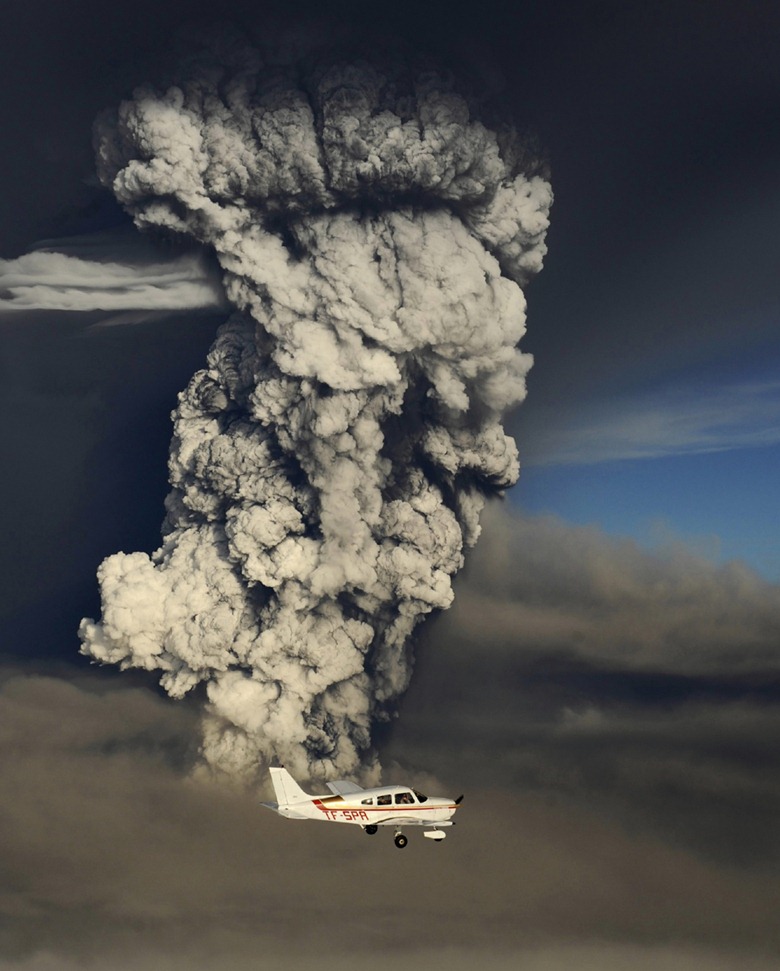
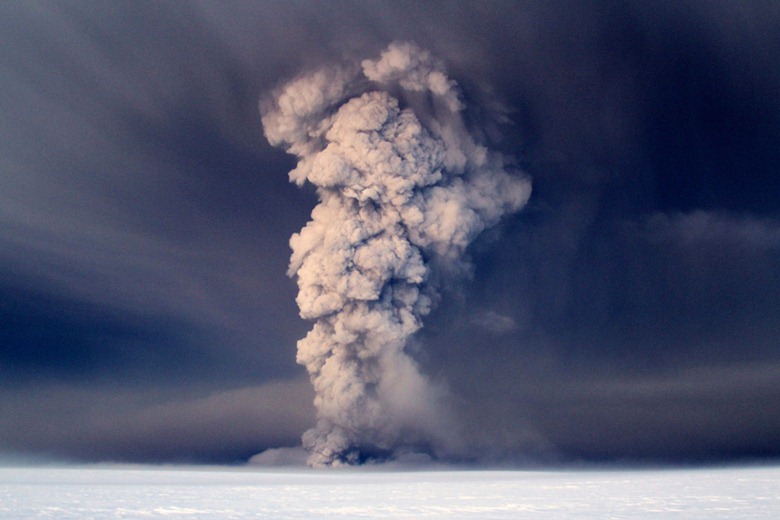
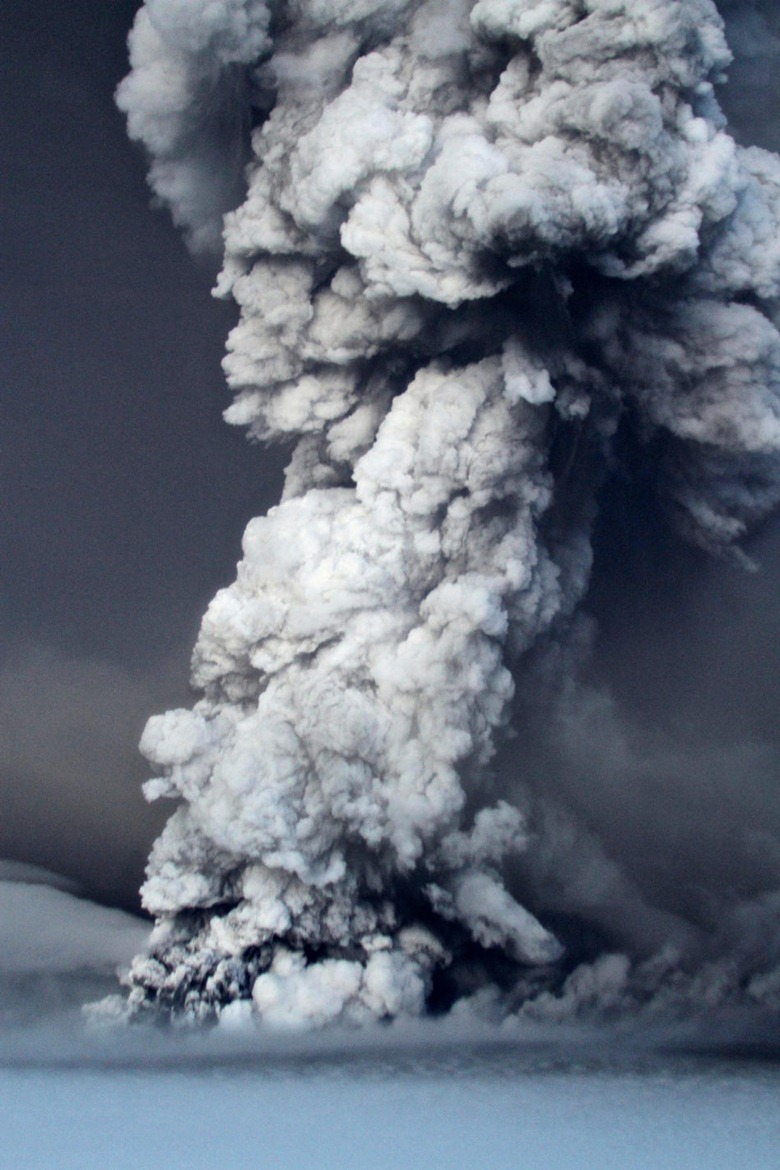
The Grimsvotn volcano began erupting on Saturday, sending clouds of ash up to 12 miles into the air. The amount of ash spewing from the volcano tapered off dramatically on Tuesday, however, said Elin Jonasdottir, a forecaster at Iceland’s meteorological office. She added that because the plume has decreased in height – it’s now at about 5,000 meters (16,000 feet) – the ash won’t travel far and will most likely fall to the ground near its source. Although not as huge as the Eyjafjallajokull eruption, in April 2010, the eruption of the Grimsvotn volcano, under the Vatnajokull glacier in southeast Iceland on May 21, 2011 has caused hundreds of travel delays.

Below are some stunning pictures capturing nature’s most violent phenomenon.
Grimsvotn-volcano11

APTOPIX Iceland Volcano.jpg

ICELAND-VOLCANO
Grimsvotn-volcano15
NASA MODIS satellite image acquired at 05:15 UTC on May 22, 2011 shows the plume casting shadow to the west.
Grimsvotn-volcano10
Photo: AP Photo, Jon Gustafsson
Grimsvotn-volcano11
Grimsvotn-volcano16
Agust Gudbjornsson took this photo from Hrauneyjar Hotel only couple of hours after the eruption started.
bp1
A plane flies past a smoke plume resulting from the eruption of the Grimsvotn volcano, under the Vatnajokull glacier in southeast Iceland, May 21, 2011. (Olafur Sigurjonsson/Reuters)
bp5
Grimsvotn-volcano14
ICELAND-VOLCANO-ERUPTION.jpg
Anna Hardadottir, a farmer of Horgsland, leads a horse, through the ash pouring out of the erupting Grimsvoetn volcano on May 22, 2011. Ash deposits were sprinkled over the capital Reykjavik, some 400 kilometres (250 miles) to the west of the volcano, which has spewed an ash cloud about 20 kilometres into the sky. (Vilhelm Gunnarsson/AFP/Getty Images)
ICELAND-VOLCANO-ERUPTION
Tourists leave the Islandia Hotel in Nupur as ash continue to pour out of the erupting Grimsvoetn volcano on May 22, 2011. (Vilhelm Gunnarsson/AFP/Getty Images)
Iceland Volcano
Vehicles are covered in ash near to Kirkjubaearklaustur, approx. 260 km from Reykjavik, Iceland, Monday, May 23, 2011. (AP Photo/Brynjar Gauti )
Iceland Volcano
Iceland Volcano
A dead lamb lies covered in ash near Kirkjubaearklaustur 260 km (162 miles) from Reykjavík, Iceland Tuesday May 24 2011 (AP Photo/Brynjar Gauti )
ICELAND-VOLCANO-AVIATION-ERUPTION
Britain Iceland Volcano
Passengers rest on the floor as their flights have been canceled at Edinburgh Airport in Edinburgh, Scotland Tuesday, May 24, 2011 (AP Photo/Scott Heppell)
SWEDEN-ICELAND-VOLCANO-AVIATION-ERUPTION
Passengers wait for information about their flights from Landvetter Airport in Goteborg on May 24, 2011. (ADAM IHSE/AFP/Getty Images)
bp15
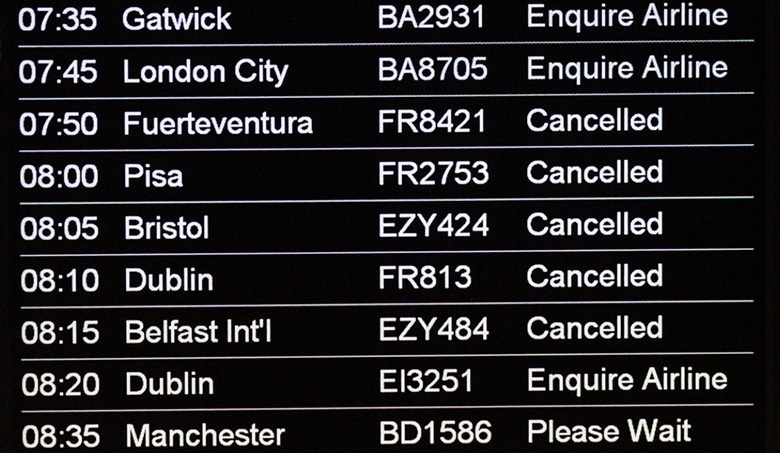
A departure board shows canceled flights as the airport remains open with limited flights at Edinburgh Airport in Edinburgh, Scotland, May 24, 2011. (Scott Heppell/Associated Press)
bp17
Airline passengers sleep as they wait for flights at Edinburgh airport in Scotland, May 24, 2011. (STR/AFP/Getty Images)
bp18
bp19
Passengers sleep on the floor in the main terminal at Edinburgh Airport, in Scotland, May 24, 2011. (David Moir/Reuters)
bp20
A passenger waits in the main terminal at Edinburgh Airport, in Scotland, May 24, 2011. Ash from an Icelandic volcano forced the cancellation of dozens of flights to and from Scotland but Ireland's Ryanair said it would protest against "unnecessary" restrictions. (David Moir/Reuters) 
bp21
bp23
An empty flight Check-In area at Aberdeen Airport in Scotland, May 24, 2011, a result of a plume of ash from an erupting Icelandic volcano headed for Britain. (Scott Campbell/AFP/Getty Images)
bp16
A deserted check-in area at Keflavik airport, Keflavik, Iceland, May 22, 2011, as Iceland closed its main international airport and canceled domestic flights. (Brynjar Gauti/Associated Press)

Wisconsin public Internet fights telecom attempts to kill it off


The University of Wisconsin's Internet technology division and a crucial provider of 'Net access for Wisconsin's educational system are under attack from that state's legislature and from a local telecommunications association. At issue is theWiscNet educational cooperative. The non-profit provides affordable network access to the state's schools and libraries, although its useful days may be numbered unless the picture changes soon.

Under a proposed new law, the University of Wisconsin system could be forced to return millions of dollars in federal broadband grants that it has already won, spend far more money on network services, and perhaps even withdraw from the Internet2 project.
Give it back

As we go to press with this story, WiscNet is negotiating with the leadership of Wisconsin's state legislature. Here's how the situation stands now: at the urging of Wisconsin's state telecommunications association, Republican legislators have introduced an omnibus bill that would sever WiscNet from the University of Wisconsin at Madison's Division of Informational Technology, and bar it from taking any money from UW.

The proposed law even goes so far as to prohibit UW from taking National Telecommunications Information Agency (NTIA) broadband stimulus grants, or joining any entity that offers broadband to the general public.

These measures would force UW to return an estimated $39 million in such funds to Washington, DC, warned Tony Evers, the State Superintendent of Public Instruction, last week. And they would force schools to turn toBadgernet, Wisconsin's state wide-area-network, which depends heavily on AT&T as its primary vendor.

"These provisions will have a devastating impact on the University of Wisconsin System campuses and our schools and public libraries," Evers told the state legislature following the bill's passage from a Joint Finance Committee on Friday June 3. "You cannot have a renowned research institution, like the UW-Madison, without having access to such networks."

We spoke with David Lois, Executive Director of WiscNet, on Saturday; he's busy working with legislators to avert disaster. "We're looking for opportunities to move forward and we're working on some sort of compromise, but it's difficult when we're beginning at this point," he told Ars.

University of Wisconsin economic development professor Andy Lewis is also involved in the negotiations. "I think this has always been about the telcos getting us to return those stimulus grants," he explained. "I think that this has been about what it has been all about from the beginning."

This is a development of huge significance; the University of Wisconsin helped invent the 'Net as we know it.
Wisconsin's idea

Were it not for the University of Wisconsin-Madison, the Internet might look very different. Three decades ago, Wisconsin engineers and scientists pioneered the Computer Science Research Network (CSNET)—an affordable Internet Protocol based infrastructure that would link computer science departments across the country. CSNET addressed a crucial problem. Many CS departments could not or were not qualified to hook up to the ARPANET, the original IP network. Either they either did not engage in defense research or they lacked the high price tag for admission.

As a consequence, research institutions that had no ARPANET access faced extinction, as faculty and graduate students migrated elsewhere, in many instances to well funded private sector facilities with ARPANET membership.

"An exodus of computing talent from academia to industry had caused a nationwide fear that the United States would not be able to train its next generation of computer scientists," write Katie Hafner and Matthew Lyon in their history of the 'Net, When Wizards Stay Up Late.

So Madison invited six other universities to a meeting, then lobbed a series of proposals over to the National Science Foundation for funding. Under the final NSF plan, colleges would get affordable access to Telnet and several other early network protocols. CSNET was a huge success. Within five years, practically every computer science department in the United States had Internet access, thanks to the experiment.

But Madison's brainchild also inspired the NSF to create NSFNet—a series of regional CSNET-like projects that followed the affordable Madison educational model. "By the end of 1989, the ARPANET was gone," Hafter and Lyon write. "The NSFNET and the regional networks it had spawned became the principal backbone."

WiscNet is a state level spinoff from the CSNET idea. From 1990 through 1995, the non-profit won NSF grants to extend Internet access to all the states' colleges and universities. Then the project wired up the majority of school districts. Next came libraries and local governments. None of this could have happened without the constant assistance of the IT staff at UWMadison, which WiscNet hired to manage and run the system.

75 percent of Wisconsin's schools and 95 percent of its public libraries now get Internet access from WiscNet. Like CSNET, WiscNet became a model for educational systems across the country. It also became a target for the Wisconsin State Telecommunications Association.
Duplicate network?

In October of 2010, the WSTA launched a campaign denouncing a UW plan to use federal stimulus money to expand WiscNet's presence in four Wisconsin communities.

"A duplicate network will increase costs for everyone and impact the ability of local telecommunications providers to invest in their communities," declared WSTA's Executive Director William Esbeck. "With scare state resources, do we really need the UW using government money to stifle private sector investment and threaten local jobs and businesses?"

The trade association went so far as to suggest that UW/WiscNet's activities were unlawful. "The legal issues are being researched and lawsuits are a possibility," Esbeck insisted. "The UW does not belong in the telecommunications business . . . the current statutes are very clear on that point."

Actually, the Wisconsin statutes that Esbeck cited are anything but clear. Sure, section 16.972(2)(a) says that no Wisconsin state agency:

may offer, resell, or provide telecommunications services, including data and voice over Internet services, that are available from a private telecommunications carrier to the general public or to any other public or private entity.

But section 16.972(2)(b) offers a huge exception to (a). Departments can:


provide such computer services and telecommunications services to local governmental units and the broadcasting corporation and provide such telecommunications services to qualified private schools, tribal schools, postsecondary institutions, museums, and zoos, as the department considers to be appropriate and as the department can efficiently and economically provide.

Undaunted by these inconvenient technicalities, the group asked for "more legislative review of UW's broadband plans." Eventually, that review arrived in the form of the already mentioned omnibus legislation. Section 23 of the new proposal would prohibit the UW system from receiving or dispersing any funds from the NTIA's broadband stimulus program. Section 24 would amend current law to prevent the state's Board of Regents or UW System from providing telecommunications services "that are available from a private telecommunications carrier to the general public or to any other private entity" to anyone except the UW system itself.

Section 25 would prohibit the UW System from "becoming or remaining a member, shareholder, or partner" with any entity that "offers, resells, or provides telecommunications services to members of the general public." And finally, provision 26 specifies that WiscNet must separate itself from the UW-Madison Division of Information Technology as of July 1, 2012, and forgo the $1.4 million from the UW system intended for WiscNet in 2012-13.
Making it impossible

There are a variety of problems with this proposal from the perspective of WiscNet and Wisconsin's public colleges and schools. First, there's the spectacle of UW giving back millions of federal dollars earmarked for educational broadband upgrades. "We're trying to save the public money," Lois pleaded in his conversation with us. "We're talking about millions more to do broadband in the state."

Then, as Superintendent Evers pointed out in his letter, financially and operationally cutting WiscNet off from Wisconsin institutions will cripple its efforts.

"The provision in this legislation will very likely make it impossible for WiscNet to continue offering Internet access," he noted. "If our schools and libraries must use other Internet providers, most will pay at least 2-3 times more than what WiscNet now charges."

A UW response to the "duplication-of-services" charge contends that 100Mbps BadgerNet service currently runs $6,000 a month; 1,000Mbps goes for $49,500 a month. "These costs will likely drop with renewal of the BadgerNet contract but this has not happened yet," the statement notes. "And even when it does, the costs will likely still be too high."

And unlike WiscNet, schools will then be charged by bandwidth use. At present, "as schools and libraries continue to increase their bandwidth, their WiscNet costs remain the same," Evers writes. "With our schools and libraries facing substantial budget reductions, how can anyone justify making them pay more for less service?"

To put it in comparative terms, UW Chief Information Officer Ed Meachen told WTN News that because of the different bandwidth pricing approaches, WiscNet costs the UW system $2 million a year. BadgerNet would cost $8 million.
Height of irony

The legislature has received hundreds of letters protesting these proposals. One of the most notable comes from H. David Lambert, CEO of Internet2, the non-profit ramping up to provide 8.8 terabits per second of bandwidth to the US Unified Community Anchor Network (US UCAN). The network amounts to around 200,000 community "anchor institutions"—K-12 schools, libraries, clinics, hospitals, and community colleges. In the winter of 2010, the project received a $62 million broadband stimulus grant from the government to get this project underway.

Section 25 of Wisconsin's omnibus law would obviously cut UW off from Internet2, Lambert's letter to Wisconsin Governor Scott Walker observed.

"It would be the height of irony if sections 23-26 of the University Omnibus legislation were passed, as those provisions would prohibit the University from being directly involved in proving out further developments of innovations in the Internet that it helped create," he wrote. "This would deny the University the ability to participate in the innovation cycle that created the market for commercial providers (including those who support the 11th hour insertion of sections 23-26) to provide their services in the first place."

As for WiscNet's Lois, he seemed cautiously optimistic, at least on Saturday. "The legislators have heard the WiscNet community. They've said 'you can't do this to us'," he explained. "We're trying to come up with a reasonable compromise."

UW's Lewis thinks that most of those section paragraphs could disappear, save language forcing a return of the grants. This would force the layoff of personnel already involved in rolling out broadband to those four areas.

"This thing is entirely inappropriate," Lewis declared. "If our slogan is 'Wisconsin is open for business,' we're going in the wrong direction."

When might a new proposal emerge? "Monday at noon at the earliest. Tuesday at the latest," Lois predicts

Building a better way of Understanding Science


Anyone who has gone through the US public school system has undoubtedly been exposed to the textbook version of science as a linear process that takes researchers straight from a hypothesis through gathering data and on to reaching conclusions. Anyone who has actually taken part in science, however, knows that this presentation bears almost no resemblance to reality, where science is a community endeavor, anything but linear, and, as a result, much more exciting. A newly developed website calledUnderstanding Science is intended to capture a bit of that excitement and, in doing so, change how the US public learns science.

Judy Scotchmoor of UC Berkeley's Museum of Paleontology described the site in a talk at the American Association for the Advancement of Science meeting, and Ars talked separately to MIT's Natalie Kuldell, one of the people involved in its design. Scotchmoor said the effort grew out of Berkeley's excellent Understanding Evolution site. When doing some audience testing of that site, she said that it became clear that the public's issues went way beyond the primary topic. "It wasn't an evolution problem," she said, "it was a science problem." With that in mind, she obtained money from the National Science Foundation to tackle this problem.
Giving science a facelift

Scotchmoor showed the evolution of how science is typically presented. Back in 1986, it was introduced as a five-step program: identify the problem, gather information, form a hypothesis, test it, and reach conclusions. (I can personally confirm that this presentation significantly predates 1986.) As she moved to more recent textbooks, this definition picked up color and pictures, but remained essentially unchanged. Unfortunately, it's nearly unrelated to science as it is practiced. The centerpiece of Understanding Science is a new diagram of the scientific process that emphasizes its non-linearity and dynamic, iterative nature.

The Scientific Process (click for a larger version)

The Exploration and Discovery section emphasizes that research topics don't simply drop out of the sky. Luck, new instrumentation, and unexpected results all play a role, as does personal motivation—lots of scientists are in their current field because of the equivalent of "I think dinosaurs are neat." Once motivated, the process of getting to the point where you can actually test ideas involves everything from initial observations to talking to other people in the field. It's anything but a dry "gather information" bullet point and Understanding Science brings that out.

Testing ideas remains central to the new presentation, but it's no longer a one-pass, thumbs up or down on a hypothesis. Instead, the data need to be interpreted, and researchers are often forced to go back and either revise their hypothesis, or the assumptions on which the hypothesis is based. No matter what happens, the arrows in the diagram make it clear that this isn't a one-shot deal, as multiple rounds of testing and revision are needed to refine ideas.

The traditional presentation of science might lead students to believe that it is a solitary activity, conducted by researchers acting in isolation. But it's not simply enough to convince yourself; to achieve anything significant in science, you have to build a consensus and convince your field (see: Mendel, Gregor for an example of what happens when you don't). Kuldell emphasized the importance of ensuring that Understanding Science captures this social aspect, and it does, noting that everything from discussions with the guy down the hall to the peer review of grants and publications play critical roles in developing scientific ideas, and that the community feeds back into all parts of the process.

Finally, Understanding Science recognizes that the process doesn't simply end with a body of knowledge. Instead, scientific results help foster new technology, solve societal problems, and inform public policy. These factors also feed back into the basics of the scientific process—researchers are as likely to be motivated by the thought that they can develop a treatment for a disease as they are by the fact that dinosaurs are neat.
Integrating the improvements into education

This new presentation of science was a joint effort of everyone from high school teachers to philosophers of science, as well as a few practicing scientists, so it shouldn't be a surprise that it gets so much right about the scientific process. But, as the example of Mendel shows, it's one thing to be right, and another thing entirely to be useful. Fortunately, the site is about far more than simply the scientific process, as a quick trip through some of the additional material there should make clear.

There are sections about various aspects of science—why science matters, what constitutes scientific evidence, science as a human endeavor, etc.—and each of these are interlinked. For example, the What is Science page links to both a page on Misconceptions about Science and a checklist that helps students identify whether a process is scientific or not. The interconnections among these topics are intended to help reinforce the basic aspects of science, as a one-off mention may not really bring home how important many of these things are.

Also available on most pages are links to teaching material relevant to that topic. These include lesson plans targeted at different grade levels, as well as advice on how to integrate the material within a larger course. All of the graphics and PDFs are provided with a license that allows their noncommercial use, so teachers can grab pretty much anything on the site.

The path taken during the development of the impact/extinction theory demonstrates the iterative and nonlinear nature of science

My favorite aspect, though, is its description of some major scientific discoveries, all of which also link back to teaching material and on-site resources. Its section on the discovery of the structure of DNA makes it clear that this was truly a community effort. It also doesn't shy away from noting that some parts of the community were dragged into the process through behavior that's widely seen as unethical. Its section on how the father-son team of Alvarezes developed the impact theory for the dinosaur extinction is truly excellent, and ends with an animation showing their path through the scientific process diagram that's central to the site. As Scotchmoor put it, "it's messy, it's complicated, but that's science."

MIT's Kuldell argued that it's the messiness that makes science compelling. "If you presented it in its truthful form, it's so fun and so exciting, and yet it's presented in this simplified, stripped down version," she said, "It's not that it's out and out wrong, it just doesn't adequately reflect what's really exciting about it. I do have to believe that if you teach people how fun science is, you will get more people interested in science. Kids love science and at some point they stop liking it and I think it's because they are told there's a right answer, and they either get it or they don't. They lose the query, the 'I wonder what would happen if.' And that's a pity."

The last part of being useful, however, is making sure people know this resource is out there. Scotchmoor ended her talk at AAAS by saying that, although the NSF funded putting the site together, that money did not include any way of informing the wider educational community. Which is where her talk at AAAS, which led to this article, may come in. If you find the content at Understanding Science compelling, then it would be great to make any educators you know aware of its presence.
source

LinkWithin